27%
Applications connected
Only 27% of the average enterprise's 957 applications are integrated (Salesforce, 2026).

The ERP, CRM, finance, HR and legacy systems your company runs on, connected so data moves between them automatically, stays in sync and stays under your control. Designed, built and run by one team on a monthly retainer.
The average enterprise runs hundreds of applications that don't talk to each other. Staff fill the gaps by hand with exports, spreadsheets and retyping, and every gap is a place where data goes stale or wrong.
Only 27% of the average enterprise's 957 applications are integrated (Salesforce, 2026).
40% of IT leaders name outdated architecture, caused by data silos and disconnected systems, as their primary blocker to using data for AI (Salesforce, 2026).
96% of IT leaders say AI agent success depends on seamless data integration across systems (Salesforce, 2026).
Source: Salesforce Connectivity Benchmark Report 2026, a survey of 1,050 IT leaders.
Accounting, billing, purchasing and inventory, reconciled across systems instead of by hand.
Customers, deals and orders kept consistent from first contact to invoice.
People, roles and access kept in step across every system that needs them.
The specialist systems your industry runs on, connected to the rest of the business.
Decades-old platforms connected without replacing them.
Vendor portals with no API, inboxes and scanned documents, turned into data your systems can use.
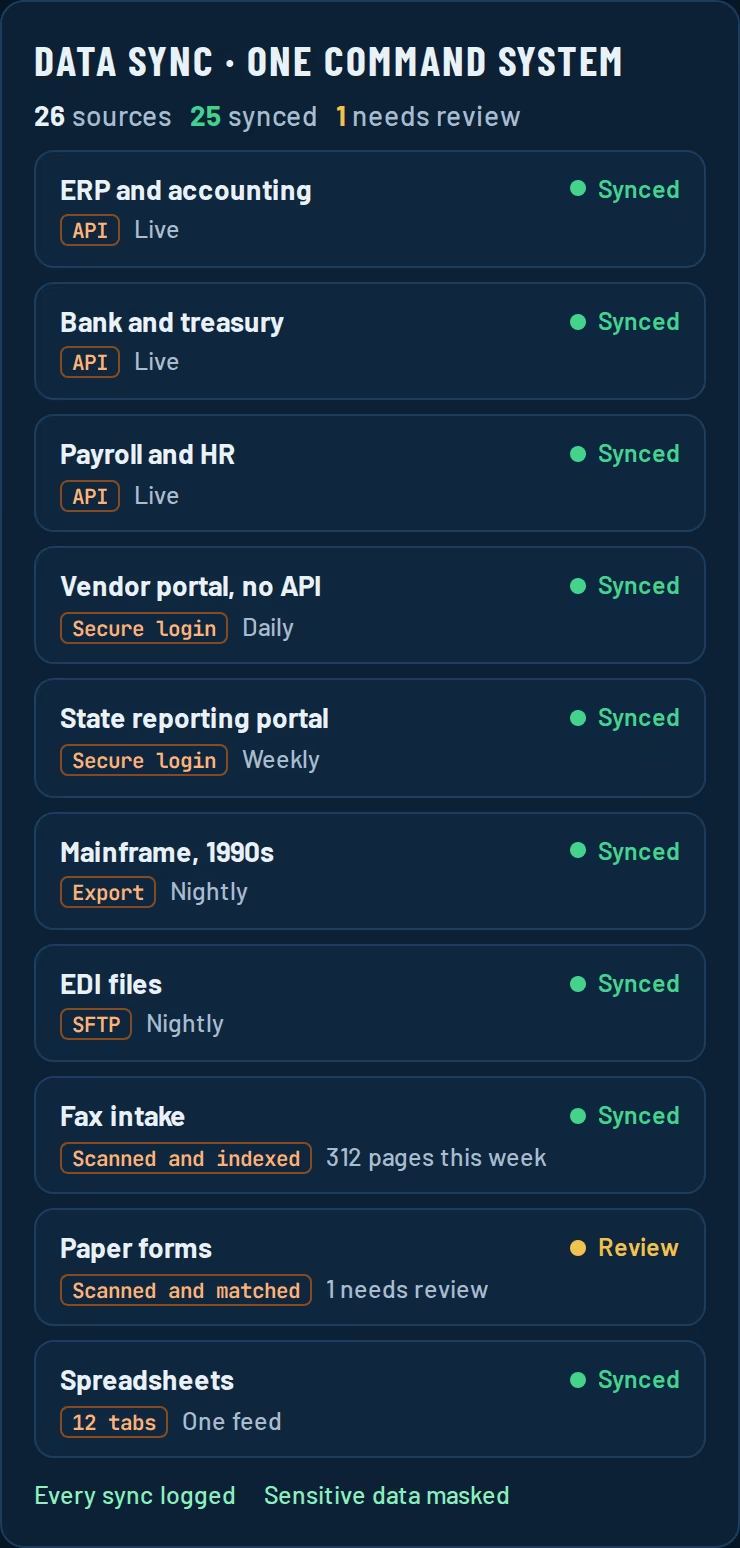
We connect read-only wherever possible, and write back into a system only where you approve it.
Each piece of data has one owner system, and every other system stays in sync with it.
Changes that matter, such as payments, records and customer messages, can require a person to approve them.
If a connection stops or data looks wrong, you know right away instead of finding out at month-end.
What moved, where, when and why, in a full audit log.
Access keys are kept in encrypted secret storage, with least-privilege access for every connection.
Private AI and AI agents can only answer from, and act on, the systems they're connected to. Enterprises now run an average of 12 AI agents, and half of them work in isolation (Salesforce, 2026). Integration comes first, so AI works from complete, current data, under the same access controls as everything else.
AI on servers you control, answering from your connected systems.
See private AIAgents that act across connected systems, with spend caps and human approval.
See AI agentsEvery connected system on one screen, with alerts, approvals and an audit log.
See the Command CenterThe same safeguards come standard in every system we build.
Our secure private cloud, your own cloud account or your own servers. Private AI scales up instantly with demand.
With private AI, prompts, documents and answers never go to an outside AI company.
People see only what their role allows, and AI never answers from documents they can't open.
Who did what, and when, including every AI and agent action, recorded in an audit log.
Every AI and agent has a hard budget. It stops and reports before it goes over.
Documented handover. The system is yours.
We learn the problem, the systems you run and how sensitive the data is, and find where the biggest return is.
Design, build, operation and new work under one monthly retainer. Terms renew every 90 days, and you can cancel with 30 days' notice.
We build and connect to the systems you already run, then monitor, update and keep them compliant. A daily work log, upcoming work and an updates log are always open to you.
Video meetings with the builders. You review what shipped, your feedback sets the next priority, and we take on the next problem.
No. We connect the systems you already run. Fixing the gaps between platforms rarely requires replacing any of them.
We connect it anyway, through vendor portals, file exports, email or scanned paper, with a health check on every feed.
We connect read-only wherever possible, so nothing is written back into a system until you approve it.
Systems Integration connects your platforms so data moves between them. The Command Center is the screen on top that shows every connected system in one place. Integration is the foundation it's built on.
You do. You own the system, every integration is documented, and you're never locked in.
Monthly retainer only, in 90-day terms paid monthly. No build fees and no fixed quotes.
Tell us which systems need to talk to each other.