Patient and health records
Charts, claims, intake notes, lab results.
We set up your own private LLM: on your own computers, in a private cloud account you control, or in the Victor Vauss secure private cloud, hosted and managed by us. Your team gets the AI they already want to use. Your contracts, patient records, student records and source code never go to an outside AI company.
Staff are already pasting company information into public chatbots, because it saves them hours. Each paste sends that text to servers you don't own, in a place you didn't choose, under terms you didn't negotiate. Banning AI doesn't work. Giving your people a private one does.
Charts, claims, intake notes, lab results.
Transcripts, IEP notes, discipline and advising files.
Privileged documents, deal terms, disputes.
Formulas, drawings, product plans, trade secrets.
Payroll, pricing, forecasts, board materials.
Names, accounts, histories, support tickets.
Today's AI prices don't cover what the service costs. OpenAI has committed to about $300 billion of computing from Oracle over five years starting in 2027, roughly $60 billion a year, while its own revenue is forecast at about $36 billion for 2026. The Financial Times reports it expects to burn $278 billion in cash between 2026 and 2030. Services like this keep running only as long as investors keep paying the bills. We don't believe that lasts. When the money tightens, prices from the major Western providers will keep climbing, and the only cheap computing power left will most likely come from China.
It has already started. OpenAI priced GPT-5.5 at double GPT-5.4, and GitHub Copilot moved from flat-rate requests to metered billing in June 2026. We expect more of the same as investors stop covering the losses.
We expect the low-cost AI that remains to come mainly from Chinese companies, served from data centers in China, priced to undercut everyone else.
Chinese law requires companies to support and cooperate with state intelligence work. Anything sent to a Chinese AI service should be treated as readable by the PRC government. Chinese models must also follow the PRC's content rules, so their answers reflect the PRC's priorities, not yours.
Our position: sensitive data should never sit on servers under a government that doesn't respect privacy and can compel a company to hand over everything, at any time, for any reason. A private AI on your own hardware takes that risk off the table.
Across large organizations the pattern is the same: staff adopt AI faster than IT can approve it, nobody can see what it costs in real time, and the people accountable for it don't control it.
of CIOs and CTOs say AI adoption is outpacing their governance (IBM, 2026).
of organizations suspect or know that staff use prohibited public AI tools (Gartner, 2025).
lack real-time visibility into what they spend on AI (IBM, 2026).
scaled back or redesigned AI plans this year because of token costs (Cloudera, 2026).
Every concern executives name about AI comes back to control. Here is each one, the number behind it, and what changes when the AI is yours.
89% scaled back or redesigned AI plans over token costs. 45% moved workloads because of cost swings, and only 27% can measure AI cost very accurately (Cloudera, 2026).
When it's yoursNo per-token bill set by someone else. You set the capacity and the spend cap, so the cost is a budget line, not a surprise.
AI grows from about 15% of IT budgets in 2025 to about 25% in 2027 (IBM, 2026).
When it's yoursHardware you own or reserved private cloud capacity. Heavy use does not multiply the bill the way per-token pricing does.
85% lack real-time visibility into AI spend (IBM, 2026).
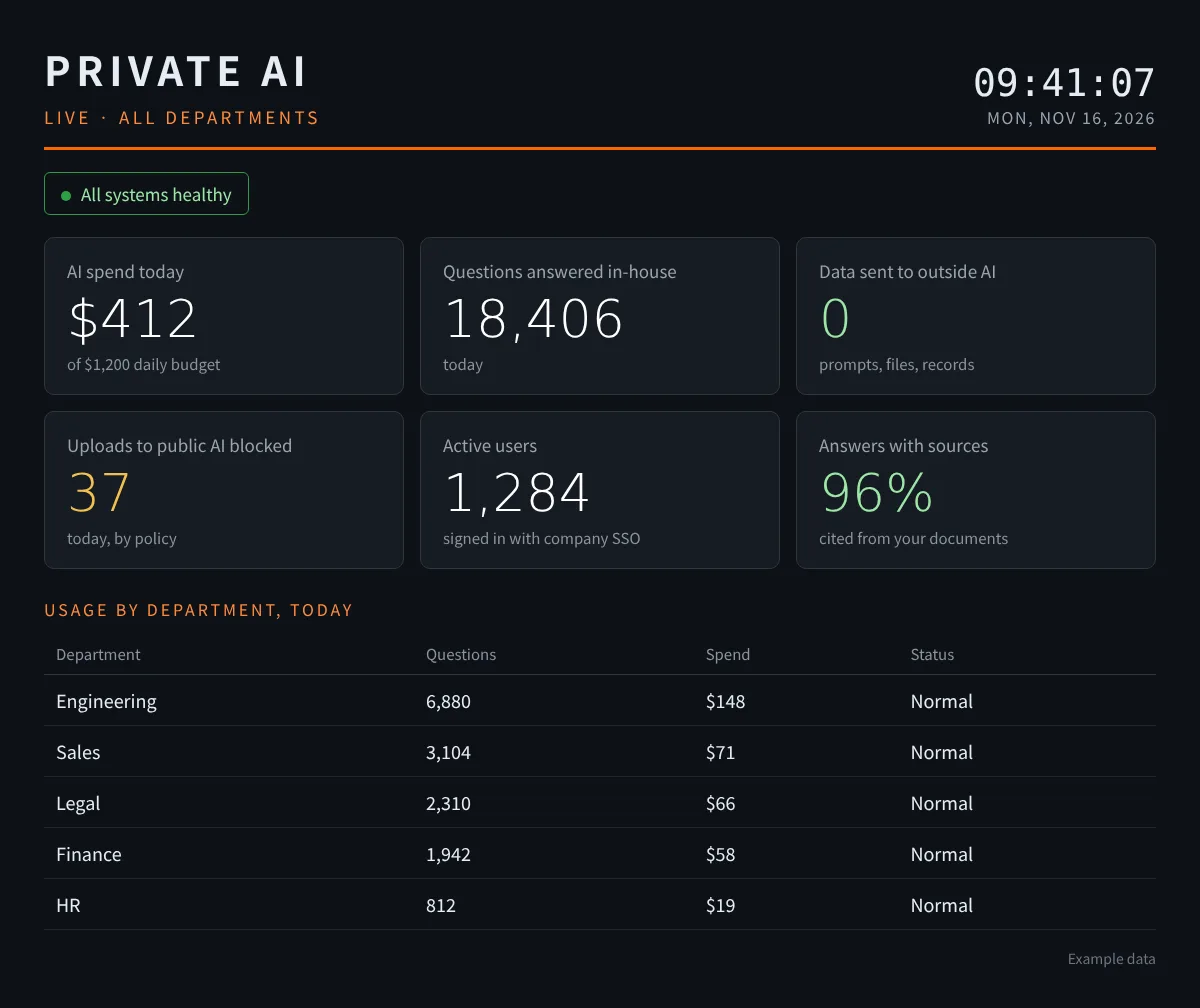
When it's yoursEvery prompt, user, department and cost on one live dashboard.
69% suspect staff use banned public AI tools. Shadow AI added about $670,000 to the average breach (Gartner, 2025; IBM, 2025).
When it's yoursGive staff an AI as good as the public tools, block uploads to the rest, and nothing leaves your servers.
77% of CIOs and CTOs say adoption outpaces governance, and 70% say business teams deploy AI faster than IT can track (IBM, 2026).
When it's yoursOne approved AI, behind your single sign-on, with role-based access and a full audit log.
Only 11% feel ready to run agents at scale. The average enterprise has 54 AI agent incidents a year, and 37% of the severe ones exposed data (IBM, 2026).
When it's yoursAgents run inside your network with spend caps, human approval and access limited by role.
59% name security and compliance as the top barrier to scaling AI agents (IBM, 2026). CEOs rank data privacy (46%) and security (35%) as the top AI risks (IDC, 2026).
When it's yoursData stays on servers you control, with no third-party processor. HIPAA, FERPA, APPI and PIPL are handled by design.
In Japan, output accuracy is the top generative AI concern at 50.4% (Teikoku Databank, 2026), and 35.3% of firms need a human final check and explainable answers (JIPDEC, 2026).
When it's yoursAnswers grounded in your own documents, with sources, automatic checks and human review where it matters.
Skills shortage is a top barrier for 41.3% of Japanese companies (Teikoku Databank, 2026).
When it's yoursWe build it and run it. Your team just uses it.
Providers can change prices, terms or models at any time, and most companies have no fallback.
When it's yoursYou own the system and can switch models whenever you like.
Contracts, source code, customer and patient data pasted into tools you don't control. Shadow AI added an average of $670,000 to the cost of a breach (IBM, 2025).
Sending personal data to an outside AI vendor can trigger HIPAA, FERPA, Japan's APPI and other rules on third-party processing and cross-border transfer.
AI vendors change prices, rate limits and terms on their own schedule. Your budget follows theirs.
Workflows built on one provider's tools are expensive to move when that provider changes direction.
Answers that sound right and aren't. Without sources and logs, nobody can show where an answer came from.
Data on servers under another government's jurisdiction can be demanded by that government.
A private AI is a large language model (LLM) that runs on computers you own, inside your network. It works like the AI chat tools your team already knows: it drafts, summarizes, translates, searches your documents and answers questions. The difference is where it runs. Nothing is sent to an outside AI provider, and it keeps working with the internet unplugged.
We're systems architects. We choose the model, specify the hardware or cloud, install it, connect it to your documents and systems, set who can use what, and keep it running. Tell us what your team needs. We work out the rest.
The model runs on servers or workstations you own. No shared cloud.
Reachable only from inside your network, or fully air-gapped with no internet at all.
You decide who can use it, what it can read, and what gets logged.
Not every company wants servers in the building. We offer two private cloud options. Both scale up instantly when demand spikes and back down when it's quiet, and neither sends a prompt or document to an outside AI provider.
We install a fully secure private AI in a cloud account you own and control, such as AWS, Microsoft Azure or Google Cloud, in the region you choose. Your data never leaves servers you control.
More computing power is added automatically at peak times and released when it's idle, so you pay for what you use, not for an AI vendor's margin.
It runs in your own cloud account, in the country you choose, under your contracts and your security policies.
Your encryption keys, your access controls, your logs. No outside AI company ever receives a prompt or a document.
Hosted and managed by Victor Vauss, for enterprises that want no hardware on site, no cloud account of their own to run and no public AI service involved. We run it; you keep full control of who uses it and how.
Computing power is added automatically at peak times and released when it's idle, so the whole company can use it at once.
Your single sign-on, access rules by role and department, spend caps you set, and a full audit log of every prompt and action.
The model runs in our private cloud, not on a public AI service. No prompt or document ever goes to an outside AI company.
Access is designed around how sensitive the work is. Most companies combine two or three of these.
Open a browser on the office network and chat, the same way people use public AI tools. Nothing to install on each computer.
Staff ask questions and get answers drawn from your policies, contracts, manuals and files, with the source shown. Each person only gets answers from documents they're allowed to see.
The AI appears inside email, documents, spreadsheets, chat and your internal systems, so nobody has to switch screens.
Staff outside the office reach the AI through your company's own VPN, on company devices. The data still sits on your server.
Other software calls the AI through a private internal API. This is how AI agents, automated reports and a command center use it.
For the most sensitive work, the AI runs on a network with no internet connection at all. Updates are carried in by hand.
When the AI runs on your hardware, the hardest compliance question about AI goes away: no outside AI vendor ever receives your data. We've built production systems in HIPAA and FERPA environments, and private AI follows the same rules.
Protected health information stays on hardware you own. No prompt, record or transcript is sent to an outside AI vendor, so there is no third-party AI processor to vet, contract with or audit. Access is role-based, every question and answer is logged, and data is encrypted in transit and at rest. These are the access-control, audit and transmission safeguards the HIPAA Security Rule asks for.
Student education records stay under the institution's direct control. Nothing is disclosed to an outside AI provider, so staff can use AI on transcripts, advising notes and student files without creating a new third-party disclosure.
Privileged documents, deal files, source code and formulas never touch a third-party server. Confidentiality is enforced by the system, not by a policy memo.
Customer financial information, payroll and board materials stay inside your network, with a record of who asked what and when.
Compliance depends on how a system is set up and run. We build to your compliance team's requirements and hand them the access records and logs they need.
Take a company spending $20,000 a month on AI services today. If the subsidies end and prices rise as we expect, the same usage costs this:
| Scenario | Per month | Per year |
|---|---|---|
| Today | $20,000 a month | $240,000 a year |
| 10x | $200,000 a month | $2.4 million a year |
| 25x | $500,000 a month | $6 million a year |
| 50x | $1,000,000 a month | $12 million a year |
| Victor Vauss secure private cloud | We host and manage the AI in our secure private cloud. It scales instantly with demand, runs under your single sign-on, access rules and audit log, and uses no public AI service. | Enterprises that want no hardware on site and nothing to run themselves |
Illustrative figures. A private AI replaces the per-use bill with your own computing cost and a fixed monthly retainer, and neither moves when an AI vendor reprices.
| Option | How it works | Best for |
|---|---|---|
| On-premise server | A server in your office or data center runs the AI for the whole company. | Most organizations |
| Air-gapped | The same, on a network with no internet connection. | Defense, legal, research, the most sensitive records |
| Dedicated workstation | One powerful computer serves a small team or a single department. | Small teams, pilots |
| Your own private cloud | The AI runs in a cloud account you own and control, scales instantly with demand, and uses no shared AI service. | Companies that don't want hardware on site |
| Victor Vauss secure private cloud | We host and manage the AI in our secure private cloud. It scales instantly with demand, runs under your single sign-on, access rules and audit log, and uses no public AI service. | Enterprises that want no hardware on site and nothing to run themselves |
We install and maintain the private hardware the AI runs on, on site at your offices or off site at a location you choose. This service is available in Japan only, and some restrictions apply.
Your IT team runs the hardware, and we set everything up remotely through the access you provide.
Our recommendationUnless you need an air gap, choose the cloud. It's secure, scales with demand, is easy to manage and is available anywhere, in your own cloud account or in the Victor Vauss secure private cloud.
Who asked what, when, and which documents the answer used.
Each person and department sees only what they're cleared for.
Staff sign in with their existing company account.
Your data is never used to train anyone else's model.
In transit and at rest.
We handle updates, new models, monitoring and fixes.
A fixed monthly retainer and computing cost you control, instead of a per-use bill that rises with every new user and every price change.
Every question and answer logged, access by role with single sign-on, encryption throughout, and the system running inside your own network or cloud.
No third-party AI processor to contract with or audit, data kept in the jurisdiction you choose, and the records your compliance team needs.
Your whole company uses AI this quarter, without betting your data or your budget on someone else's pricing.
One team, one retainer, nothing hidden.
Design, build, support and new work, all under a single monthly retainer.
Retainers run 90 days and renew automatically. Cancel with 30 days' notice.
A daily work log, the work coming up and an updates log, inside your systems or our client portal, plus daily or weekly email updates.
Video meetings up to twice a week with the people building your system.
We build in hardened, secure environments by default, or inside your own cloud or data center when your policies require it.
Role-based access, audit logs and encryption in everything we build.
Who will use it, for what work, and how sensitive the data is.
We choose the model and specify the hardware or cloud, access and safeguards.
On your hardware, connected to your documents and systems.
Training for your team, then updates and support.
A private AI is a large language model that runs on computers your company owns, instead of on an AI vendor's servers. Staff use it like a public AI chat tool, but prompts, documents and answers stay inside your network.
Not with an on-premise deployment: the model runs on your hardware and needs no internet connection to work. For the strictest cases we build it fully air-gapped, on a network with no internet at all. If you choose the Victor Vauss secure private cloud, the AI runs in our private cloud instead of your building, and your data still never goes to an outside AI provider.
Software by itself isn't HIPAA compliant. Compliance comes from how a system is deployed and run. A private LLM on your own hardware keeps protected health information away from any outside AI vendor, and we build in the role-based access, audit logs and encryption the HIPAA Security Rule calls for.
Yes. Because the AI runs inside the institution's own network, student education records are not disclosed to an outside AI provider. Access is limited by role and every use is logged.
For everyday work such as drafting, summarizing, translating, searching documents and extracting data, current open models running on your own hardware do very well. The largest cloud models still lead on the hardest reasoning tasks. If you want both, we can set up a split where only non-sensitive work is allowed out.
It depends on how many people use it and how large a model you need. A small team can run on one workstation with a strong graphics card. A whole company needs a dedicated server. We specify the hardware. In Japan, we can install and maintain it for you, on site or off site (some restrictions apply). Anywhere, your IT team can handle the hardware while we set everything up remotely through the access you provide. Cloud deployments run anywhere: in a private cloud account you own, or in the Victor Vauss secure private cloud, which scales with demand. Unless you need an air gap, we recommend the cloud: it's secure, scales with demand and is easy to manage.
Yes. We connect it to your files, policies and systems so answers come from your own material, with sources shown. It respects permissions, so nobody gets answers from documents they can't open.
No. Your prompts and documents stay in your own storage and are never used to train a model for anyone else.
We do. Updates, newer models, monitoring and fixes are part of ongoing support, through access you control.
Price isn't the risk. Chinese companies are legally required to cooperate with state intelligence work, and Chinese AI models must follow the PRC's content rules. We advise against sending any sensitive data to these services. A model downloaded and run fully offline on your own hardware sends nothing back to its maker, but it still carries the content rules it was trained under, and we choose models with that in mind.
That's our prediction, not a guarantee. Whichever way prices move, running AI on your own hardware turns an unpredictable per-token bill into a fixed cost you control.
A private AI doesn't depend on their pricing. You pay for your own computing power and our retainer, and neither changes when an AI vendor reprices.
Yes. In your own cloud account or in the Victor Vauss secure private cloud, it adds computing power automatically when demand rises and releases it when demand falls, and no data ever goes to an outside AI provider.
Through a monthly retainer with 90-day terms that renew automatically, cancellable with 30 days' notice. You see a daily work log, upcoming work and an updates log, and meet the team by video up to twice a week.
Tell us who would use it and what kind of data is involved. We'll tell you what it takes.
Related: Enterprise Command CenterAbout Victor VaussAI Efficiency