The biggest model for everything
Simple tasks like sorting an email are sent to the most expensive model available.
Most companies overpay for AI and can't tell when it's wrong. We measure where the money and the mistakes come from, then fix both: the right model for each task, less waste in every request, and answers grounded in your own documents and checked before anyone relies on them.
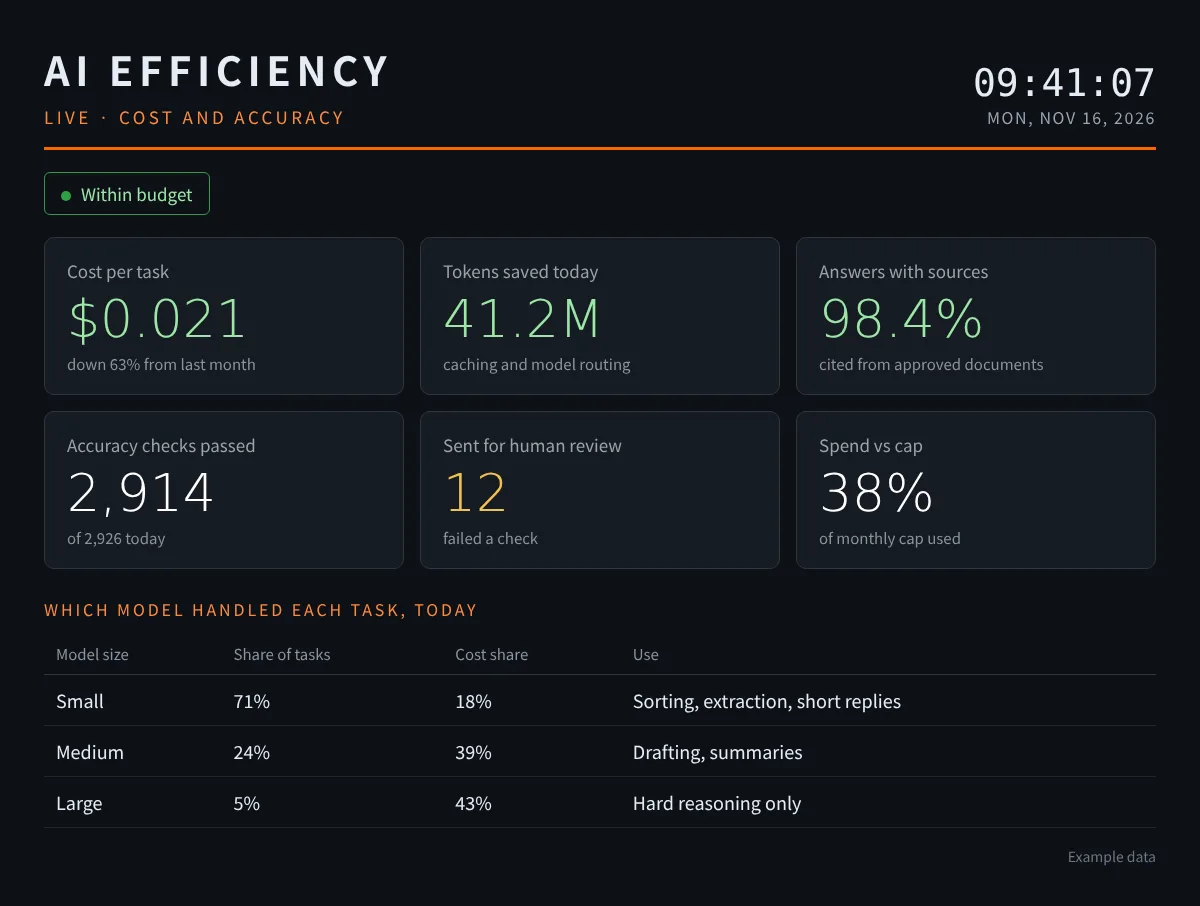
Per-token prices have fallen, yet enterprise AI bills keep climbing. 89% of companies scaled back or redesigned AI plans this year because of token costs, and only 27% can measure their AI costs very accurately (Cloudera, 2026). Accuracy is the other worry: it is the top concern of Japanese companies using generative AI, at 50.4% (Teikoku Databank, 2026).
Simple tasks like sorting an email are sent to the most expensive model available.
The same long files and instructions are resent with every request, and paid for again.
Answers that sound right, with no source, no check and no record of how they were produced.
You pay for every token the model reads and writes. The bill is driven by which model you use, how much text you send it each time, how often the same work is repeated, and how many attempts it takes to get a usable answer.
Accuracy follows the same logic. A model answering from memory guesses. A model answering from your approved documents, with a check at the end, can show its work.
The largest models can cost many times more than small ones for the same task.
Every page of text you send is billed, on every request.
Re-running the same request, or retrying failed ones, multiplies the bill.
Each change is measured before and after, so you see exactly what it saved.
Small, fast models handle routine work. The largest model is used only for the tasks that need it.
Instructions and documents that repeat are cached, so you don't pay full price to send them again.
The AI pulls only the relevant passages from your documents instead of reading whole files every time.
Work that doesn't need an instant answer runs in batches, at a lower price where providers offer one.
Instructions tightened and answers kept to what's needed, so fewer tokens go in and out.
Every workflow has a budget, a live meter and an alert before it overruns.
Accuracy is designed in, not hoped for.
Answers come from your approved documents and data, with the source shown, instead of the model's memory.
Outputs are checked against rules, formats and the source text. Anything that fails is flagged instead of sent.
Contracts, customer messages and financial figures go to a person before they leave the company.
We build a test set from your own examples and measure accuracy before go-live and after every model or prompt change.
No AI is perfect. The goal is that you always know which answers were checked, where they came from and who approved them.
| Change | What it does | Best for |
|---|---|---|
| Model routing | Matches each task to the smallest model that handles it well. | High-volume routine work |
| Caching | Stops paying full price for repeated instructions and documents. | Long, repeated context |
| Retrieval | Sends only the relevant passages, not whole files. | Large document collections |
| Private AI | Replaces per-token billing with your own computing cost. | Heavy, steady use and sensitive data |
Spend by workflow, model and department, as it happens.
Limits that stop overruns before they happen.
Every grounded answer shows where it came from.
Your own examples, used to measure accuracy.
Every request, answer, check and approval recorded.
We keep adjusting as models and prices change.
We review your current AI use, bills and failure points.
We show where cost and errors come from, workflow by workflow.
We apply the changes and measure cost and accuracy before and after.
Ongoing monitoring as your usage, the models and the prices change.
Because usage grows faster than prices fall, and much of it is waste: the largest model used for simple tasks, whole documents resent with every request, and retries. Fixing how AI is used usually matters more than the price per token.
Not when tasks are matched properly. Routine work like sorting, extraction and short replies runs well on small models. We test on your own examples before switching anything, and keep the larger models for the tasks that need them.
We build a test set from your real cases with known correct answers, and score every model and prompt against it before launch and after every change.
Yes. When answers are drawn from your documents, each one shows the passage it came from, so anyone can check it.
No. We can work with the providers you use now, move work to a private AI, or combine both.
Measuring comes first, so you see where the money goes before anything changes. Each saving is then verified as it is applied.
Tell us how your company uses AI today. We'll show you where the cost and the errors come from.
Related: Private AIAutomations and AI AgentsEnterprise Command Center